
How to Get More HVAC Reviews: HVAC Review Generation & Reputation Management Guide
A step-by-step guide to getting more HVAC reviews through on-site video capture, seasonal timing, and reputation management systems that work without chasing customers.
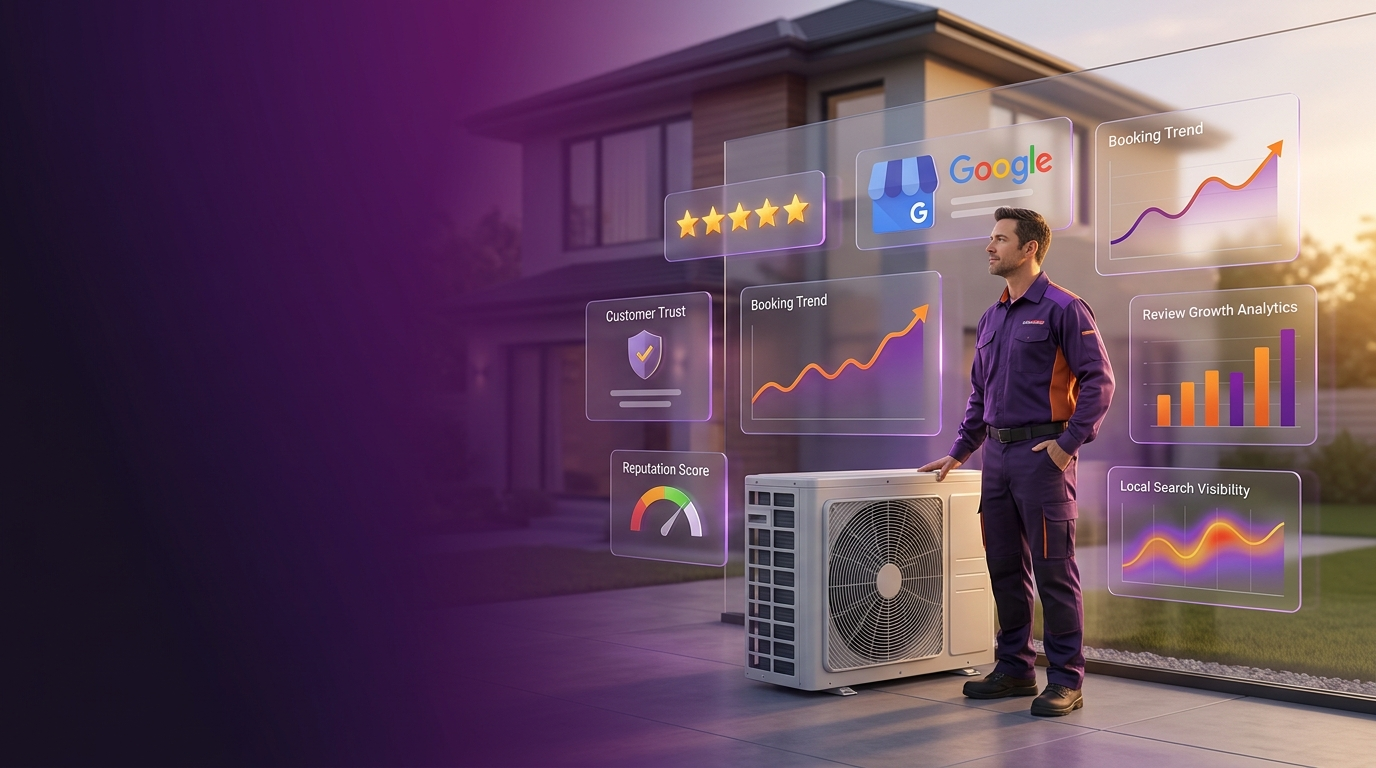
The AC in a homeowner's house stops working at 6 p.m. on a Friday in July. They pull out a phone, search "AC repair near me" on Google Maps, and three results come up. Out of the three, one company has 340 reviews and 4.9 star rating. Another one has 60 reviews and 4.3 star rating.
They make the first call. This goes on thousands of times a day in every service district in the nation, and it is quietly determining who will be called and who won’t.
What is HVAC reputation management?
Reputation management in the HVAC industry is the constant effort of collecting customer reviews, responding to reviews, and keeping your business listings updated so that the homeowner searching for HVAC services will find your company as the first choice and credible. If you're looking for a done-for-you system, HVAC reputation management software handles most of this automatically.
This guide focuses on the part contractors struggle with most: actually getting more reviews, consistently, without chasing customers down. It also includes one aspect that is overlooked by most guides: how AI platforms such as Chat GPT, Google AI mode, and Perplexity are analyzing your reviews and determining if they should recommend you.
Home Services Review Management: Why It Matters More than Just HVAC
In order to get a grasp on where HVAC fits into the bigger picture, let's take a step back and discuss home services review management as a whole.
Why this is important: homeowners don’t make judgments about HVAC service providers independently. Instead, they are comparing your review record with all the service businesses that they have hired before, from landscapers to electricians. If the HVAC provider next door to you manages its reviews better than you do, then the difference is visible right away when they search for reviews.
The businesses winning this category share three habits:
They collect reviews at the moment of service completion, not days later
They respond to every review, positive or negative, within 24 to 48 hours
They keep their review volume growing steadily instead of in occasional bursts
None of this is complicated. It's just consistent, and most contractors aren't doing it consistently.
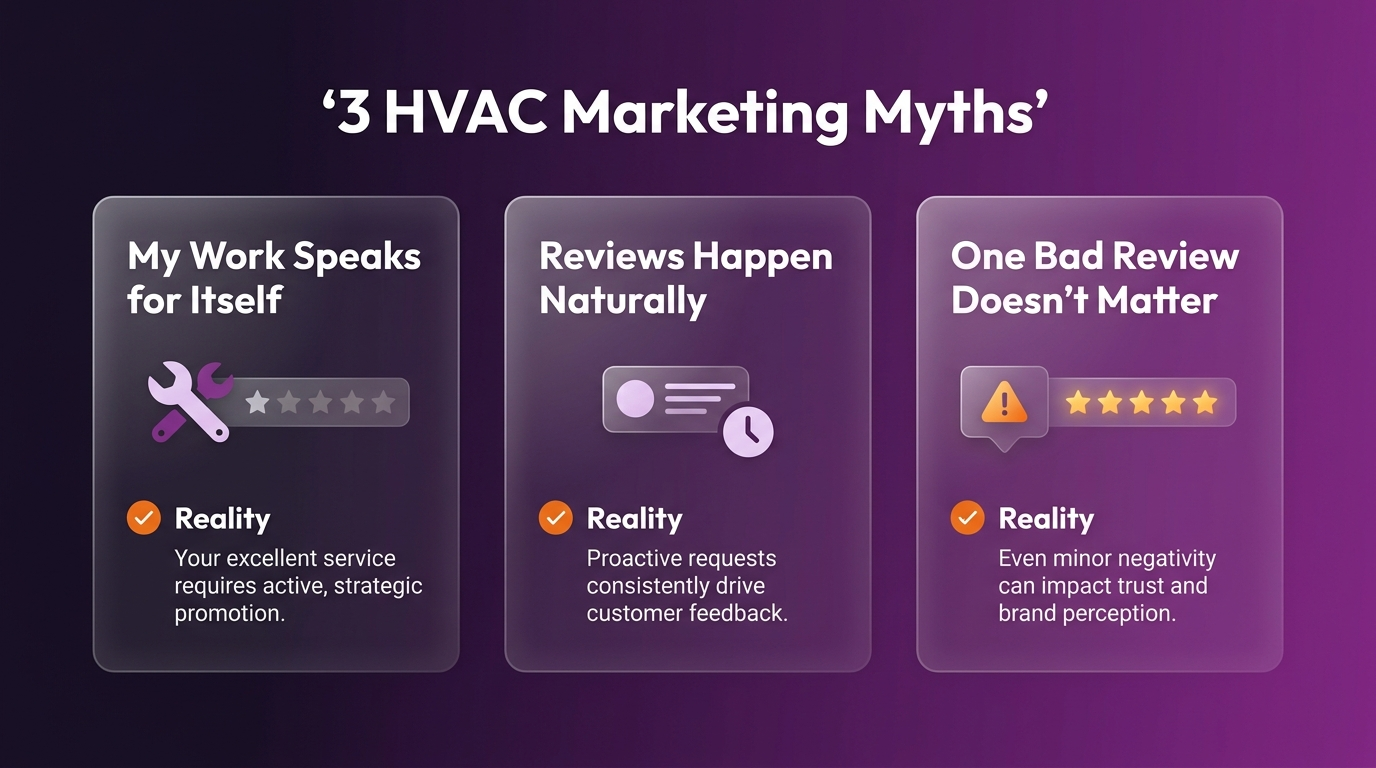
HVAC Review Generation: The Modern System
Most HVAC companies still generate reviews the old way: a technician finishes the job, hands the customer a card or mentions a text will be coming, and hopes for the best. The response rate on this approach is low, typically in the 5 to 10 percent range industry-wide.
There's a better way, and it comes down to timing and friction.
Aspect | Old Way (SMS/Email Only) | Modern Way (On-Site Capture) |
When you ask | Hours or days after the job | Before the technician leaves |
How you ask | Text or email link, hope they click | QR code scan on-site |
Format | Star rating + optional text | Video testimonial + star rating |
Typical response rate | 5 to 10 percent | 40 to 70 percent |
Content value | Text review, limited SEO/social use | Video content you can repurpose for social, website, ads |
The core insight is simple: the highest-intent moment to ask for a review is the second the job is done, and the customer is standing there satisfied, not three days later when the memory has faded, and the text message is buried under twenty others.
QR code-based on-site video review collection removes almost all the friction. The customer scans, records a 30-second clip, and it's done. No app to download, no login, no typing out a paragraph on their phone. And unlike a plain star rating, a video review gives you content you can turn into social posts, website testimonials, and ad creative.
If you want to check exactly what's allowed when asking for reviews, Google's own review policies for Business Profiles spell out what counts as a compliant request and what can get a profile suspended.
For the Google side specifically (review links, Business Profile setup, and why some links get ignored), see our guide on how to get more Google reviews.
Home Services Reputation Management: The Bigger Picture
Zooming back out, reputation management for any home services business rests on three numbers that matter more than anything else:
Star average. The number customers see first. The minimum here is 4.5, but 4.7 to 4.9 is when you’re regularly beating the competition.
Review volume. The more reviews a business has, the harder it is to beat them. For example, a business with 250 reviews at 4.7 will almost always outrank a business with 15 reviews at 5.0. High volume indicates that a large number of people, not just the owner’s circle of acquaintances, have used their services.
Review recency. If a business hasn’t posted any reviews for three months, it’s assumed by Google’s algorithm to be abandoned. Consistent posting of reviews, especially if there’s at least one per week, indicates that the business is alive and well.
It’s much better to pay attention to all three of these factors together, rather than getting hung up on just the stars.
HVAC Review Management: A Step-by-Step System
Once you're generating reviews consistently, managing them well is what protects and compounds that effort.
Ask at the right moment. The technician asks in person, right after the customer confirms the system is working and they're happy. A simple line works: "If we earned a five-star review today, I can pull that up for you right now before I head out."
Automated follow-ups, once only. If an onsite request does not work initially, a single automated follow-up within 24 hours is sufficient to get hold of those customers who were supposed to provide you with reviews but forgot about that. A second follow-up will appear as pestering.
Route reviews to one dashboard. Reviews scattered across Google, Facebook, and your website are impossible to manage well. Consolidating them into a single view means nothing slips through, especially negative reviews that need a fast response.
Track reviews by technician. Knowing which technician is generating strong reviews and which one is generating complaints lets you coach proactively instead of finding out about a problem only after it's cost you a customer.
Never pay for reviews. According to Google guidelines, it is strictly prohibited to bribe customers to write a review when they would not have written otherwise. The penalty for such a violation is deletion of all your reviews and suspension of your Google Business Profile.
HVAC Review Request Scripts You Can Use Today
Most technicians skip the ask because they do not know what to say. Give them the words. Keep each script short, specific to the job, and easy to say yes to.
In person, after the customer confirms the system is running:
"Glad we got the cooling back on before the weekend. Reviews are how most people find us. If you have 30 seconds, scan this and say a few words about today. It opens right in your phone's camera."
Text message, same day (only if they did not leave one on site):
"Hi Sarah, this is Mike from Coastal Air. Thanks for having us out to fix the AC today. If we earned it, a quick review helps other homeowners find us: [link]. Thank you!"
Email, for maintenance-plan or commercial customers:
Subject: How did today's furnace tune-up go?
"Thanks for trusting us with your system. If you have a minute, we would value a review of today's visit: [link]. If anything was not right, reply to this email and I will fix it personally."
Notice what is missing: no discount, no gift card, no "only if it is five stars." Offering incentives or asking only happy customers breaks Google's review policies.
How Many Reviews Does an HVAC Company Need?
There is no universal number. The target that matters is set by the three companies currently showing in the Google Maps three-pack for "AC repair" or "furnace repair" in your service area. To set yours:
Search your main service terms from inside your service area and note the review count, star average, and date of the latest review for the top three results.
Take the highest review count among them. That is your 12-month target.
Divide the gap by 52. If the leader has 300 reviews and you have 90, you need about four new reviews a week to catch up in a year.
Compare that weekly number to your completed jobs. A crew finishing 25 calls a week only needs about one in six customers to leave a review, which is very achievable with on-site capture.
Recency matters as much as the total. A steady four reviews a week beats 40 reviews in one month followed by silence.
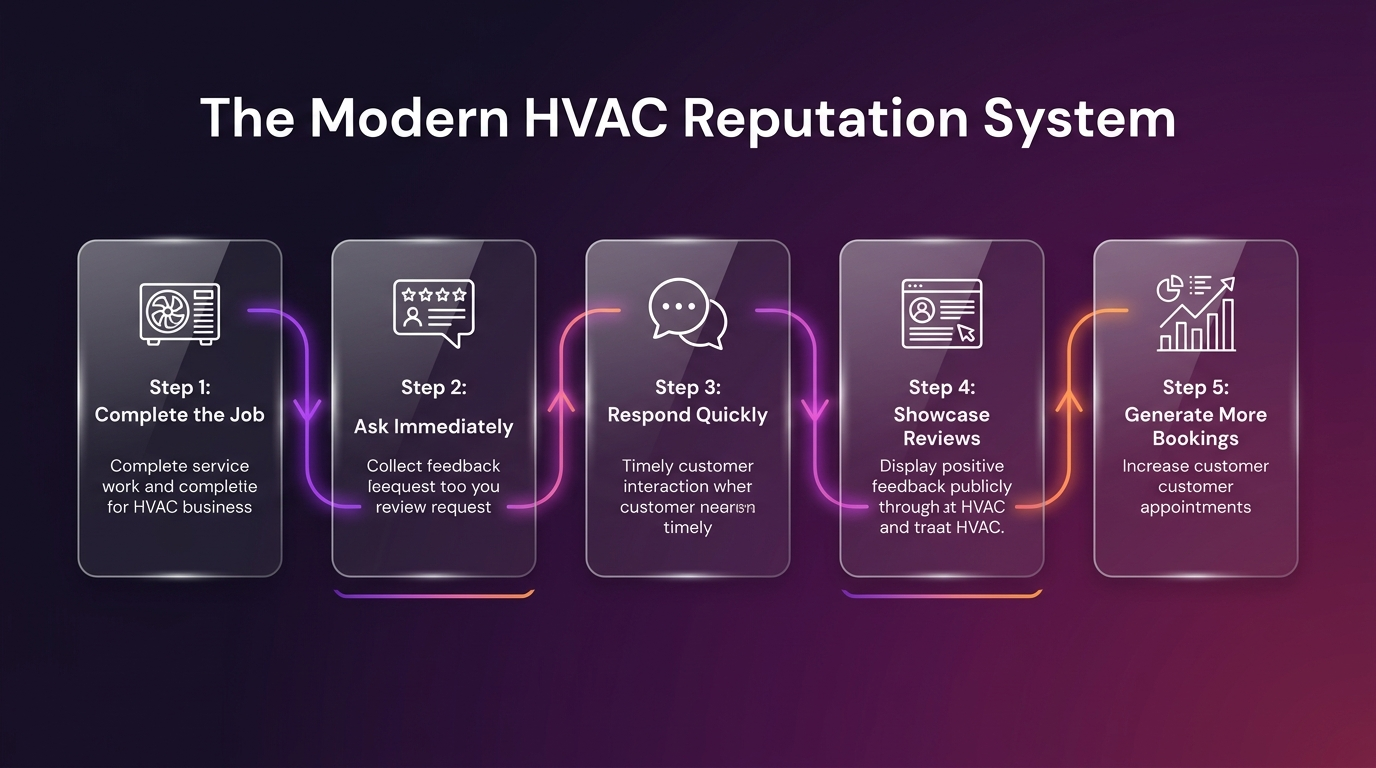
Home Service Contractor Reputation Management: Managing the Negative Reviews
Every HVAC contractor will eventually receive a negative review. But what you do in response is much more important.
A response to a negative review is often much more credible than an additional five-star review. A homeowner who browses your reviews will come across the negative review first, then the way you responded, which will be enough evidence for him that you take your issues seriously.
The framework that works:
Respond within 24 hours. Speed signals you take feedback seriously.
Acknowledge the specific complaint. Generic "we're sorry you had a bad experience" reads as scripted and can make things worse.
Move the resolution offline. Offer a direct line to a manager, then take the details out of the public thread.
Never argue the facts publicly. Even if the customer got something wrong, a public dispute damages trust with every future reader, not just that one customer.
Flag genuinely fake reviews. However, when a review violates the guidelines set by Google (off-topic reviews, competitor vandalism, profanity not related to the experience of receiving the service), you should file a complaint using the reporting mechanism on your Google Business Profile with proof. Many times, Google does indeed remove such complaints.
For word-for-word replies you can adapt, see our negative review response templates.
Seasonal Review Strategy for HVAC Contractors
However, the general rule for managing the reviews suggests collecting the reviews throughout the year, which cannot be applied in the HVAC business where demand is definitely not constant.
Summer peak (air conditioning repair and installation): The call volume goes up, technicians become busy, and sending a request for leaving a review can easily slip through the fingers. This is the exact time when a quick and frictionless request right at the site will work best since no further campaign can be made after.
Winter peak (furnace and heating repair): Urgent calls prevail. Once the customer's home gets heated back up, it becomes a great opportunity for requesting a review, sometimes even better than at the maintenance call.
Spring and Fall shoulder seasons: The slower volume will give you time to do more follow-up sequences as well as review calls that you may have skipped in either the summer or winter periods.
In building this cycle into your process, you’re not utilizing a static process throughout the year and missing the opportunities where customers say “yes.”
Building a System That Works Without You Chasing It
The contractors pulling ahead on reviews aren't the ones with the fanciest software. These are the people who know when the right time is to ask, every time, making it easy for the customer to say yes.
This is the entire concept of frictionless: catching customers when they are happy and allowing the reviews to add up from there.
Sync Reviews is built around this system for HVAC companies: every technician gets a QR code, customers record a short video review on site, the review lands in one dashboard with your Google and Facebook reviews, and AI drafts a reply to each one. See Sync Reviews for HVAC contractors or compare plans and pricing. Every plan starts with a 7-day free trial, no credit card.
Want to stop losing jobs to contractors with more reviews?
Start your 7-day free trial. Show your first QR code today. Have proof in your dashboard before tonight.
Start Free TrialFrequently asked questions
Ask every customer in person before the technician leaves, at the moment they confirm the system is working. Make it one step, like a QR code that opens in the phone camera, then send a single follow-up text the same day to anyone who did not leave one. Consistency matters more than any single tactic.



Stop losing jobs to contractors
with more reviews.
Show your first QR code today. Have proof in your dashboard
before tonight. 7 days free, no credit card, no contracts.