
What Is Reputation Management? Everything You Need To Know For Your Home Services Business
Learn what reputation management means, why it matters for home services contractors, and how to build a plan that protects your business while generating more leads.

Reputation management involves monitoring and managing how your business is viewed on every platform where customers look, such as Google, review websites, social media, and even AI-powered search results. This includes your reputation management efforts from start to finish: the reputation that people see when searching your business online, what people learn before calling, and what people recall after completing their work.
More than just reviews, online reputation management, or ORM, involves your Google My Business efforts, directory listing pages, social media mentions, word of mouth in community forums, and how AI tools describe your business when asked about recommendations.
Reviews are one part of this picture. For the review side specifically, including how to collect, respond to, and showcase them, we've covered that separately.
Reputation Management vs. Review Management
These terms get used interchangeably, but they are not the same thing. Review management is what you do with customer feedback specifically: collecting it, responding to it, showcasing it. Reputation management is the bigger picture, everything that shapes how a homeowner perceives your business before they ever pick up the phone.
Still working out which term applies to your situation? Check out our comparison of reputation management versus reputation marketing. And for the review side of your reputation, we've covered review management separately.
Why Reputation Management Matters for Home Service Contractors
A homeowner is letting a stranger into their home. Trust is not an option; it is the reason for the choice. This trust can be created or destroyed based on brand perception long before you even step foot on the job site.
Referrals are still a massive percentage of contractor business, and referrals in the modern world happen just as often online as they do from across the neighbor’s back fence. One customer complaint that goes unaddressed could influence public opinion about your business more than a dozen happy customers that didn’t say a thing.
There is another more recent element to consider. New AI-driven search engines like Google AI Overviews, Chat-GPT, and Perplexity use review text and references to your business on the internet to build summaries of local businesses. If you lack an online presence or the feedback is sparse, there is not a lot of content available for these search engines to utilize, making your business invisible to AI-driven recommendation engines.
The Core Components of a Reputation Management Strategy
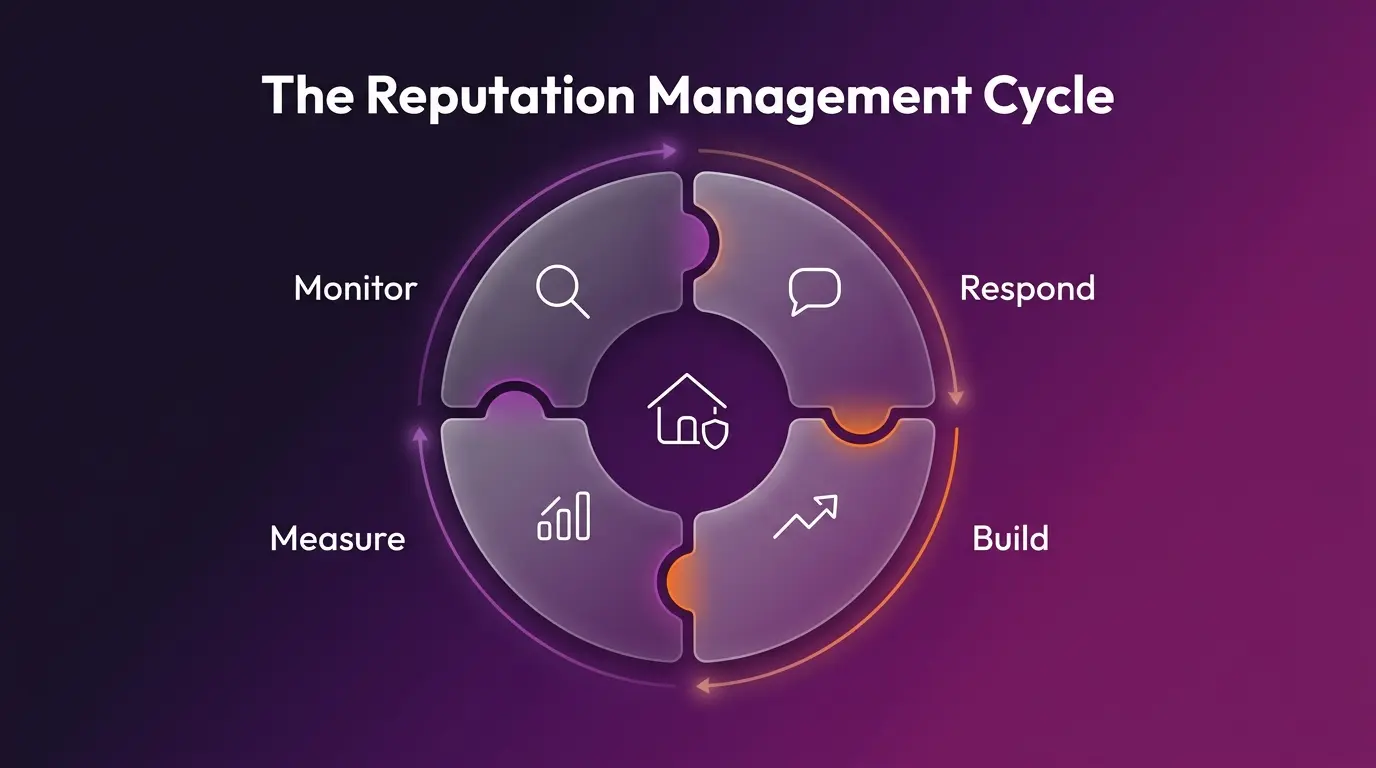
1. Monitoring
You cannot control what you do not observe. Set up Google Alerts with your business name so that all new instances will notify you instantly. Look at your Google Business Profile on a weekly basis. Track review sites, social media, and any community group within your locality that could mention your business.
2. Responding
Every response – whether to compliment or to a complaint – will be viewed by future customers to determine whether to trust you or not. Respond to compliments with a brief, direct thank you note. Respond to complaints politely without engaging in an argument.
3. Building a Positive Presence
This would include things like the quality of your Google Business Profile, the information you put out there on what you do, testimonials that are on your own site, and how you present yourself on the platforms that your customers actually use. Social proof accumulates over time. The more real and concrete reviews and content you have out there, the more powerful your position relative to your competition will be in the mind of the customer.
4. Measuring Results
Keep an eye on scores, reactions, and sentiment through time. Even a rudimentary score like Net Promoter Score (NPS) will indicate if your existing clients are likely to refer to your company or not.
Reputation Management in a One Truck Business vs. A Multiple Crew Business
The fundamental reputation management framework remains the same irrespective of the company size: monitor, react, promote, evaluate; however, the amount of structure required for this changes depending on the size of the company.
A sole proprietorship may handle this with weekly Google Alerts and the discipline of reacting to all reviews in one or two days along with a collection of testimonies that he/she can recycle in marketing efforts. There is no need for dedicated software or a dedicated person at this stage.
A multi-crew business needs something more repeatable. With more jobs happening at once, reputation management becomes harder to keep in one person's head. This is usually the point where a shared process, or reputation management software, becomes worth the cost, since it removes the risk of a bad review sitting unanswered for two weeks because nobody happened to check that day.
For a deeper look at protecting your brand at scale, see our guide on "business reputation management".
Handling a Reputation Crisis in the Trades
In the case of a service-based company, reputation damage will not look like a scandal that a corporation faces. Reputation damage in the case of a service company will consist of missing appointments leading to the writing of a bad review on the internet by the customer.
In situations like this, speed and tone become very important. The best way forward is for the company to acknowledge the issue in the public domain without being defensive. Move the details of the resolution to a private conversation. A calm, professional public response often does more to protect your reputation than the original complaint does to damage it, because future customers are reading how you handled it, not just what happened.
For a complete framework on responding to and recovering from a reputation crisis, see our guide on "handling a reputation crisis" .
How Much Does Reputation Management Cost?
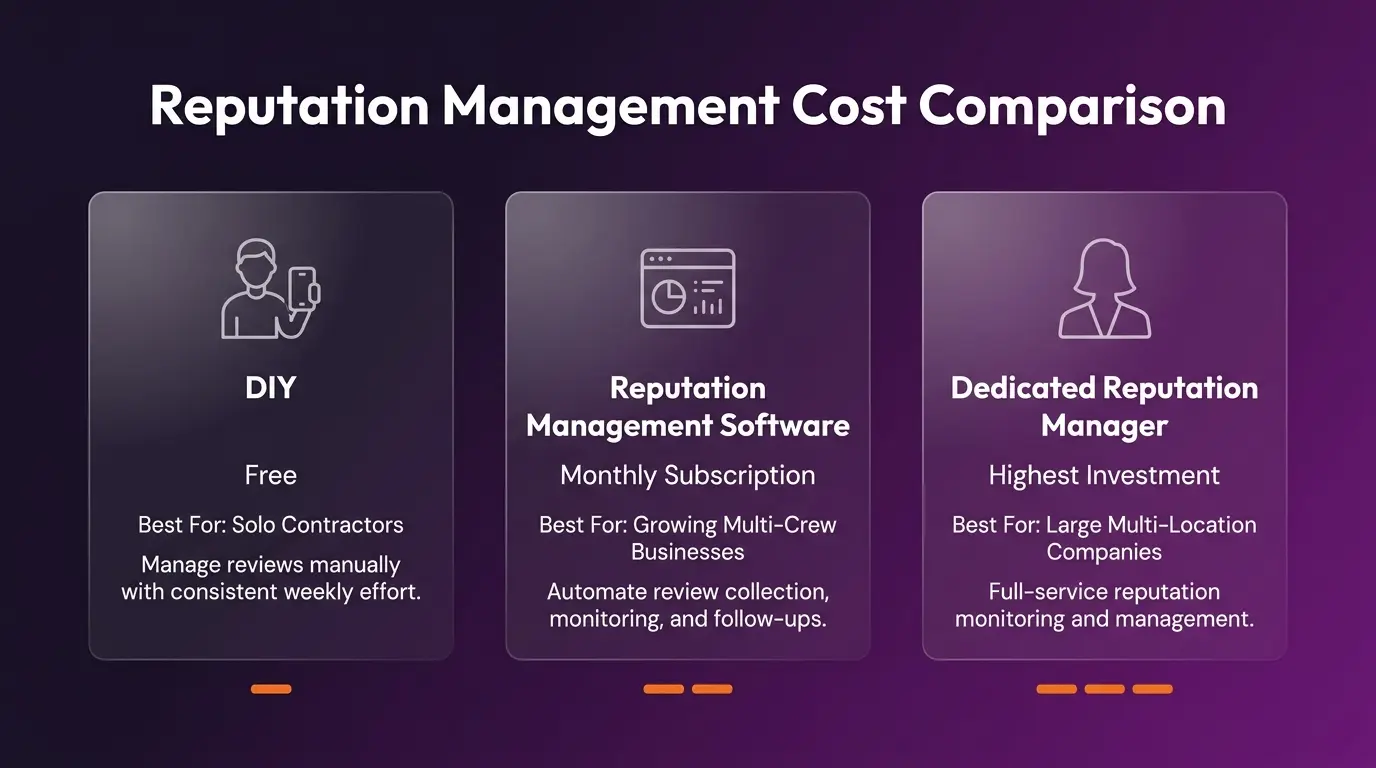
There is no single answer; it depends on how much time you have and how much risk you are carrying.
Doing it yourself costs nothing but time. A solo contractor checking Google Alerts and responding to reviews personally can manage this at zero direct cost, as long as it happens consistently.
Reputation management software is the middle option. Tools in this category typically run from a modest monthly subscription up to a few hundred dollars a month depending on features, and they remove the dependency on human memory, tracking reviews, automating requests, and centralizing monitoring in one dashboard.
Hiring a dedicated reputation manager is the highest cost option, and for most single-location home service businesses, it is not necessary. This level of investment tends to make sense only for larger, multi-location operations with a high volume of customer interactions to manage.
What Good Reputation Management Looks Like Day to Day
A simple weekly rhythm keeps this manageable:
Review your Google My Business page for any updates and messages.
Always respond to any new reviews, good or bad, within one or two days.
Look at your Google alerts for any references beyond the platforms that you monitor manually.
Publish one social proof, review, photo, customer story to your own site and social media accounts.
Finally, review your sentiment trend and NPS once a month to evaluate whether your reputation management efforts are heading in the right direction.
Final Word
Reputation management is not something you do once. It is a continuous process where you protect your reputation by constantly monitoring, responding and publishing social proofs.
If you get this right, you will be the business that homeowners trust even before making a call.
Get this right, and your business becomes the one homeowners trust before they ever pick up the phone. For a full look at our approach, see "reputation management services" .
Want to stop losing jobs to contractors with more reviews?
Start your 7-day free trial. Show your first QR code today. Have proof in your dashboard before tonight.
Start Free TrialFrequently asked questions
Reputation management is the ongoing process of monitoring and shaping how your business is perceived across every place customers look, including Google, review sites, social media, and AI search tools like Chat-GPT and Perplexity. It covers what people see before they call and what they remember after the job is done.

Stop losing jobs to contractors
with more reviews.
Show your first QR code today. Have proof in your dashboard
before tonight. 7 days free, no credit card, no contracts.