
Reputation Marketing and Review Funnels for Roofing Firms
Reviews decide who homeowners call after a storm. Learn the review funnel, response rates by ask method, and why AI search tools now read your star rating before recommending a roofer.
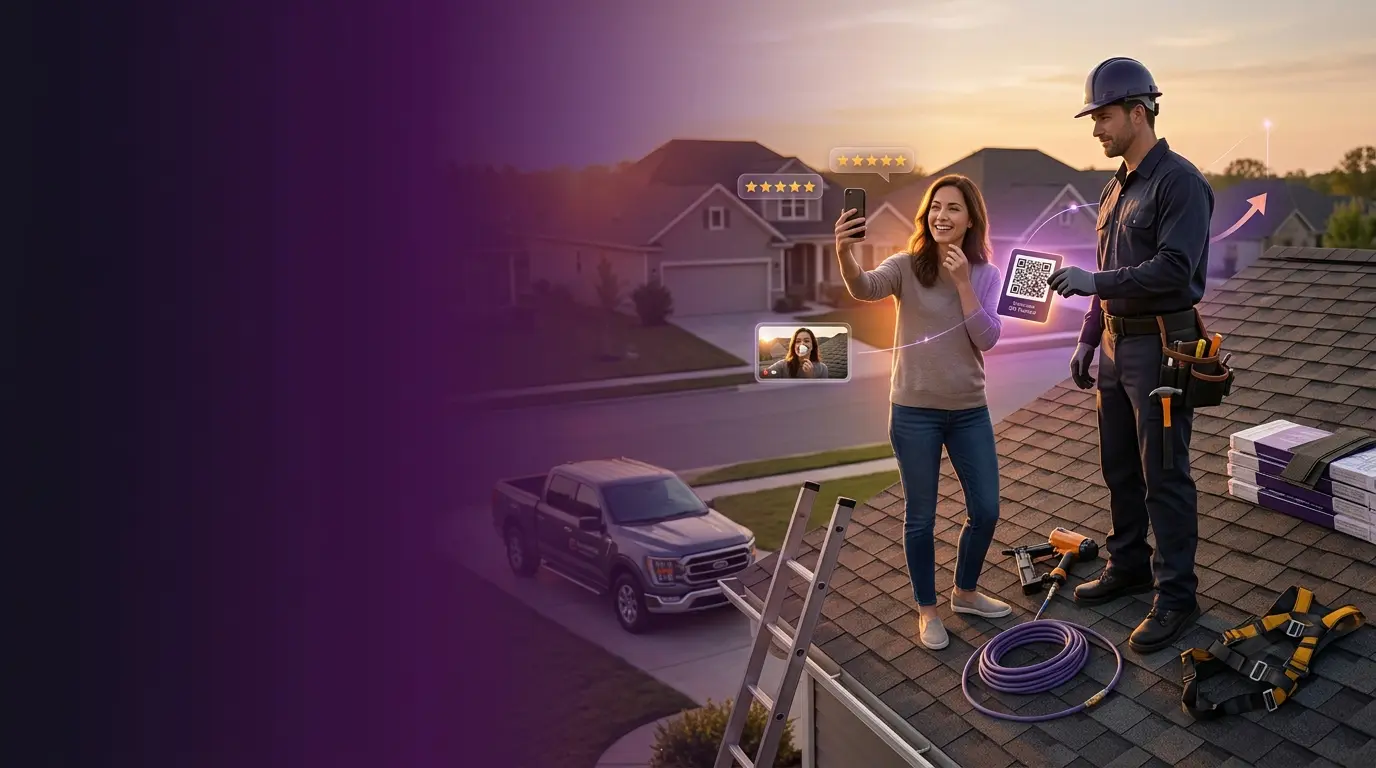
A hailstorm rolls through a neighborhood on a Tuesday. By Thursday, four roofing companies are canvassing the same streets. The homeowner isn't picking based on who knocked first. They're pulling up Google, comparing star ratings, and reading the three most recent reviews before they even answer the door.
What is reputation management for roofing contractors?
It's the continuous cycle of gathering reviews from customers, providing timely responses, and maintaining proper business listings so that, when the homeowner searches for the roofer, your company appears as the obvious, reliable choice. Review funnel refers to the system in which one completes a review from the service provided by turning it into a published review.
In this article, we'll discuss the metrics that are not covered by the majority of the roofing marketing material, including the response rate metrics, the fact that artificial intelligence tools are reading your reviews before referring you, and the review funnel.
Reputation Marketing for Roofing Firms: The Bigger Picture
Reputation marketing goes one step further than basic review management. It's the practice of actively turning your best reviews into marketing assets: website testimonials, social proof in ads, before-and-after content paired with a customer quote. This is the core idea behind Sync Reviews' roofing reputation management software: capturing reviews on-site as video and turning them into usable marketing content automatically.
The roofing companies pulling ahead treat every five-star review as raw material, not just a number on a dashboard. A review with a photo request granted, a testimonial pulled for the homepage, a quote used in a Facebook ad. That's reputation marketing. Most roofing companies stop at "collect the review" and never take the second step.
Why AI Search Is Changing the Reputation Game for Roofers
Every guide on this topic talks about Google's map pack. Almost none mention what's happening in AI search.
If a property owner were to ask Chat GPT, Google AI Mode, or Perplexity, "Who is a good roofer near me?", these technologies would rely on the same signals Google has traditionally relied on for reviews, which include stars average, number of reviews, recency, and sentiment in the review text. A roofing firm without a healthy review profile won't even be mentioned in an AI response.
This means your review strategy is no longer just an SEO tactic. It's becoming the deciding factor in whether AI tools recommend you at all.
The Three Numbers That Define Your Roofing Reputation
Reviews aren't one score. Three separate numbers drive how homeowners and search engines perceive you, and each needs its own attention.
Star average. The number people see first. Staying above 4.5 keeps you in consideration. Below 4.0, most homeowners move on without calling.
Review volume. The reason why an average rating of 5.0 with 10 reviews will always lose to an average rating of 4.7 with 200 reviews is because quantity means volume and that volume shows that your customers are real.
Freshness of Reviews. A profile whose last review was posted three months ago is inactive, and this means that Google's Local SEO algorithm and artificial intelligence will take this as an indicator of a drop in your level of trustworthiness.
What Actually Works: Response Rates by Ask Method
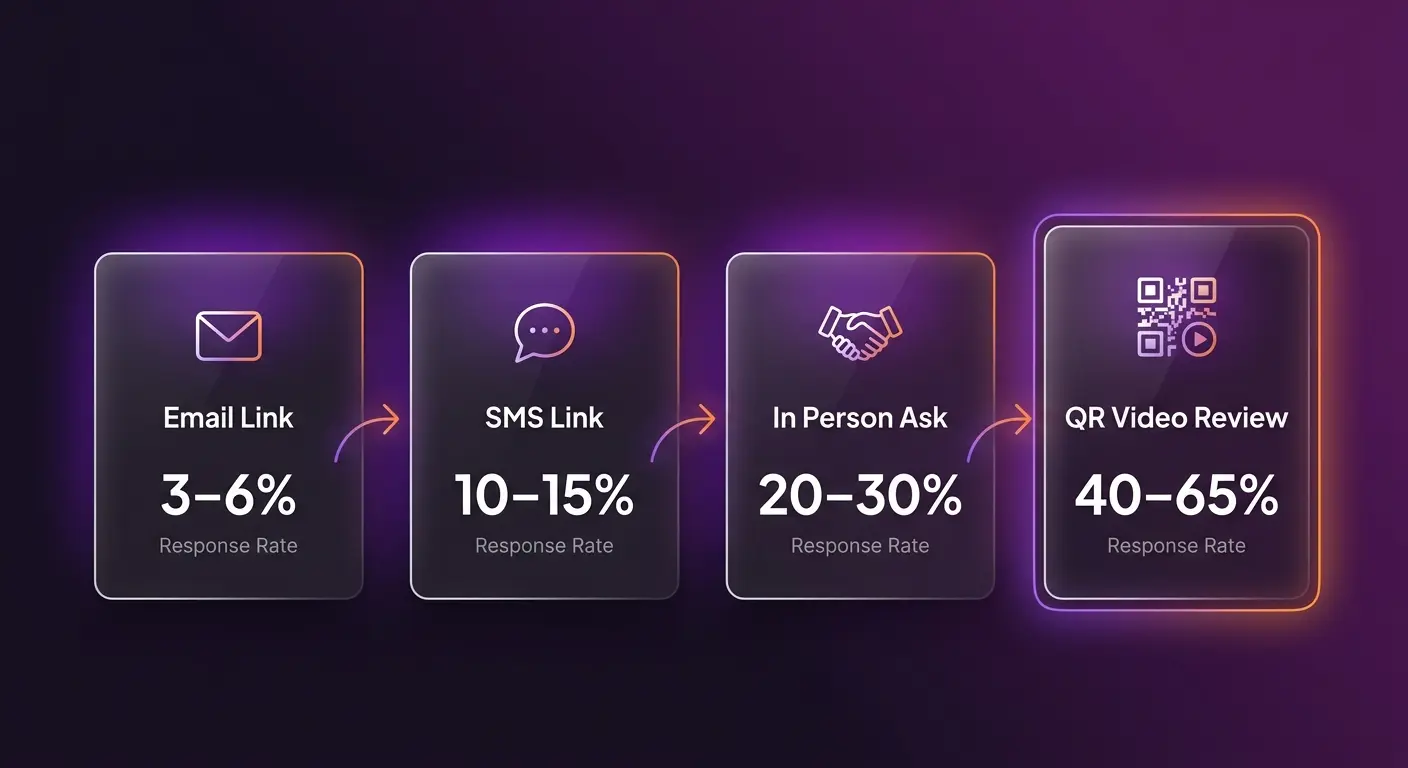
Most advice on this topic says "ask for reviews" without telling you which method of asking actually converts. Here's the real difference:
Method | Typical Response Rate | Why |
Email link sent days later | 3 to 6 percent | Memory has faded, low urgency |
Text message link same day | 10 to 15 percent | Faster, but still requires the customer to click, navigate, and type |
In-person ask before the crew leaves | 20 to 30 percent | Highest-trust moment, but still relies on the customer following through later |
QR code with on-site video capture | 40 to 65 percent | Removes almost all friction; customer records a 30-second clip on the spot |
Building a Review Funnel for Roofing Jobs
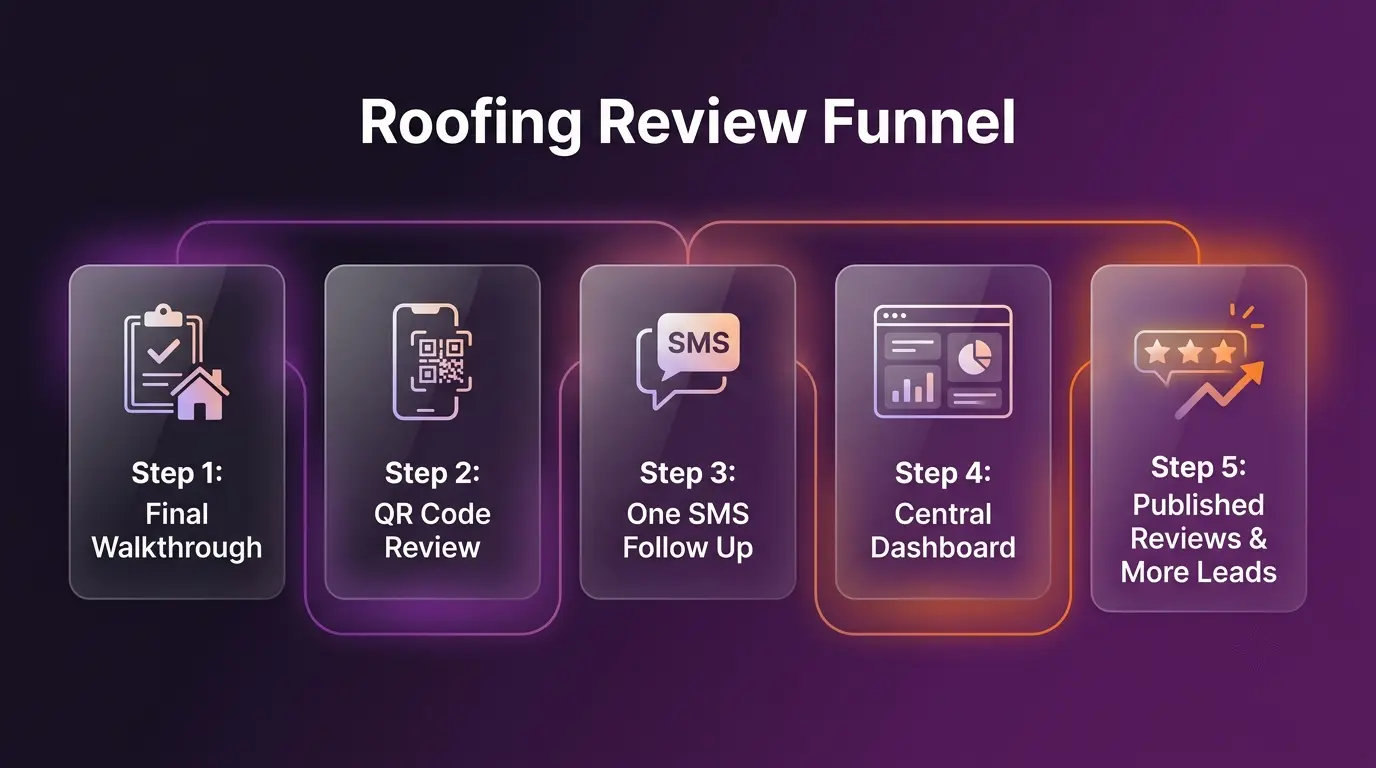
A review funnel is just a repeatable sequence, applied to every job, every time.
Step 1: Ask at the final walkthrough. The crew lead, or project manager, asks while standing next to the finished roof, not after driving away. "If we earned a five-star job today, I can get that link up on your phone right now."
Step 2: Make it user friendly. A QR code leading to a review page or an even better 30-second video prompting the review will yield much higher results than requesting people to write a paragraph.
Step 3: Send one follow-up. An automated SMS message sent 24 hours after will remind those customers who wanted to write a review but forgot. Send only one follow-up; sending another one would imply pressure.
Step 4: Centralize all feedback to one dashboard. The reviews posted in Google, Facebook and Yelp can easily get overlooked, particularly negative ones that need a quick reply. By putting all of them into one dashboard, this won’t happen.
Step 5: Never pay for a review. Google's Business Profile review policies prohibit incentivizing reviews from customers who wouldn't have otherwise left one. A violation can get your entire review history wiped and your profile suspended.
Timing Your Review Funnel to Storm Season
Roofing needs aren't consistent from month to month, and neither should your review-gathering approach be.
During storm season: Phone volume goes up rapidly, staff is busy, and review requests are one of the first things to fall by the wayside as a result. And this is precisely why a quick, easy on-the-ground ask for a review is necessary, because there won't be time to send out another multi-email review request afterwards.
During the off-season: Lower phone volume provides an opportunity to run follow-up sequences, gather any reviews missed during storm season, and address the backlog of reviews accumulated due to a busy staff.
This allows the busiest and highest-volume part of the year (storm season) to not be the lowest part of the year (in terms of reviews).
Handling a Negative Roofing Review the Right Way
Every roofing company gets a bad review eventually. How you respond often matters more than the review itself.
Respond within 24 hours. Speed signals you take feedback seriously.
Acknowledge the specific issue. A generic "sorry you had a bad experience" reads as scripted.
Move the resolution offline. Offer a direct line to a manager, then take the details out of the public thread.
Never argue the facts publicly. Even if the customer got something wrong, a public dispute damages trust with every future reader.
Flag genuinely fake reviews with evidence. If a review violates policy (off-topic content, a competitor posing as a customer, no connection to actual service performed), report it through your Google Business Profile dashboard with specific supporting evidence. Removal isn't guaranteed and can take one to two weeks, but Google does act on a meaningful share of flagged reviews.
Building a Funnel That Runs Without You Chasing It
Most roofing companies collect reviews by accident: whoever happens to feel chatty leaves one, and everyone else moves on. A real funnel flips that, making it the easy default for every satisfied customer, not the rare exception.
If you want to see how this kind of system fits into your existing workflow, take a look at how Sync Reviews works across capture, showcase, convert, and protect for field service businesses.
Want to stop losing jobs to contractors with more reviews?
Start your 7-day free trial. Show your first QR code today. Have proof in your dashboard before tonight.
Start Free TrialFrequently asked questions
Reputation marketing involves gathering online reviews and utilizing the most positive of those reviews for marketing purposes, such as adding them as testimonials on your website.

Stop losing jobs to contractors
with more reviews.
Show your first QR code today. Have proof in your dashboard
before tonight. 7 days free, no credit card, no contracts.